Blade Angle Deviations in Wind Turbine
The three rotor blades of a wind turbine should be set as equally as possible under comparable operating conditions. Differences in blade angle change the aerodynamic conditions at the rotor and can affect energy yield and turbine loads.
A measured blade angle deviation is initially just a measured value. The key question is whether and how this deviation affects the turbine during operation.
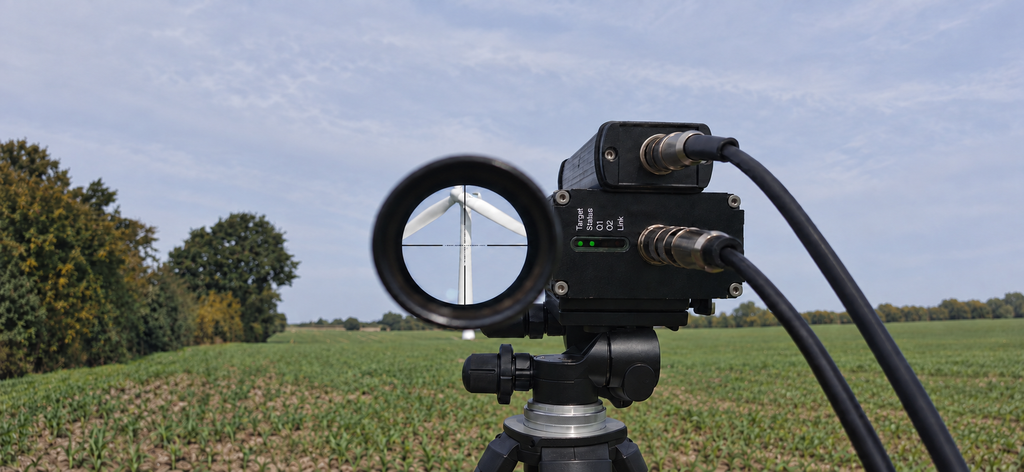
How do blade angle deviations occur?
Differences between the rotor blades can have various causes. These include deviations in pitch system settings, assembly and adjustment tolerances, or changes during operation.
The relevant parameter is the resulting difference between the rotor blades. Even small angle deviations change the aerodynamic forces acting on the respective blade.
Blade angle measurement therefore initially enables the three rotor blades to be compared with each other.
Effects on energy yield
If the rotor blades are set differently, they do not operate under identical aerodynamic conditions.
As a result, the rotor can deviate from its optimum operating condition. Depending on the operating point and the magnitude of the deviation, this can lead to avoidable energy losses.
Knowing the differences between the blade angles therefore provides a basis for identifying possible deviations from the intended rotor condition.
Effects on loads
Different blade angles result in different aerodynamic forces acting on the rotor blades. As each blade passes through the rotor once per revolution, this can generate periodic excitation.
These effects can be reflected not only in different blade movements, but also in responses of the tower and nacelle.
However, similar effects can also be caused by other rotor deviations. A measured blade angle deviation should therefore not be considered in isolation.
Measuring blade angle during operation
Blade angle deviations can be measured while the turbine is operating. The rotor blades are measured one after another under comparable measurement conditions and compared with each other.
This makes it possible to determine relative blade angle or pitch angle differences between the three rotor blades.
The advantage of measurement during operation is that the behaviour of the rotor blades under real operating conditions can be observed at the same time.
Considering blade angle and blade movement together
The movement and deflection of a rotor blade depend, among other things, on the loads acting during operation. If blade angle and blade position are measured together, differences between the rotor blades can be compared with each other.
Of particular interest is whether a blade angle deviation is accompanied by a change in blade movement.
This turns the determination of an angle difference into an investigation of actual rotor behaviour.
Including tower and nacelle response
The structural response of the wind turbine can provide additional information.
If tower or nacelle movements are measured in parallel with the rotor measurement, it is possible to investigate whether deviations in the rotor are associated with a measurable response of the turbine.
In simplified form:
Blade angle → blade movement → structural response → technical assessment
This makes it possible to investigate whether an identified deviation is merely present or whether it also has an effect on the overall system.
Not every blade angle deviation is equally relevant
A difference in blade angle does not automatically mean that a wind turbine has a relevant operating problem.
For technical assessment, the magnitude of the deviation, the operating conditions under which it occurs, and whether changes in blade movement or structural response can be identified at the same time are important.
Comparing several measurement parameters therefore enables a more differentiated assessment than determining blade angles alone.
From a measured value to turbine behaviour
Dynamic rotor measurement can combine blade angle, blade movement and structural response under real operating conditions.
Rotor LDM measures relative blade angle differences from individual blade passages. At the same time, blade position and deflection relative to the tower axis and the responses of the tower or nacelle can be considered.
Do you have questions about rotor measurement?
We would be pleased to discuss how your specific measurement task can be captured and evaluated using our laser-based measurement technology.