Relative and Absolute Blade Angles in Wind Turbines
When measuring rotor blades, the absolute blade angle is often considered first. For the operation of a modern wind turbine, however, it is equally important how synchronously the three rotor blades are set relative to each other.
The turbine control system continuously adjusts the blade angle to the wind and operating conditions. A key characteristic of a synchronised rotor is therefore that the blades follow the same control commands as closely as possible and that there are no permanent basic deviations between them.
What is an absolute blade angle?
An absolute blade angle describes the position of a rotor blade relative to a defined geometric reference.
Such a value can be relevant, for example, for assembly, adjustment or verification of a defined reference setting.
During operation, however, the pitch angle changes continuously. The turbine control system adapts it to wind speed, power output and other operating conditions. The optimum blade angle is therefore not a single value, but depends on the current operating point.
What is a relative blade angle deviation?
With the relative approach, the three rotor blades are compared with each other.
The central question is not:
What absolute angle does the blade have?
but:
How do the three rotor blades differ from each other under comparable operating conditions?
For example, if one of the three blades consistently shows an angle deviation from the other two, there is a relative basic deviation in the rotor.
The turbine control system optimises operation
Modern wind turbines continuously control their operation. Pitch angle, rotational speed and other operating parameters are adjusted to the current conditions in order to operate the turbine as efficiently as possible.
The control system can therefore change the pitch angle. However, an existing basic deviation between the rotor blades cannot simply be distinguished by the control system.
If the blades are offset relative to each other, a relative deviation between them can therefore remain.
A synchronised rotor is what matters
For a rotor that is set as uniformly as possible, the three rotor blades should be positioned as equally as possible under comparable conditions.
If all three blades follow the same control command, there should be no permanent angle differences between them. Otherwise, each rotor blade will operate under its own control condition.
In simplified form:
Common pitch control + different basic settings = different aerodynamic conditions
The relative deviation between the rotor blades is therefore an important measurement parameter.
Blade angle deviations generate cyclic additional loads
If the rotor blades are set differently, different aerodynamic forces act on them. Because the rotor rotates continuously, each blade repeatedly passes through the same load situation during every revolution.
This results in a cyclic excitation with the rotational frequency. In addition, aerodynamic forces can generate further cyclic loads and thus affect the vibration response of the turbine.
The loads acting on the rotor and nacelle are transmitted into the supporting structure via the rotor and hub. This can be reflected in different movements of the tower and nacelle.
Over the service life, cyclic loads can contribute to increased structural fatigue and therefore to higher fatigue loads.
In simplified form, the chain of effects is:
Blade angle deviation → aerodynamic imbalance → cyclic additional loads → increased fatigue loads
Why small relative deviations are important
The turbine control system can respond to changing wind and operating conditions. However, a permanent relative basic deviation between the rotor blades cannot be compensated for in the same way.
For a rotor that is as synchronised as possible, the relative blade angle deviations should therefore be as small as possible.
Because all three rotor blades do not necessarily pass through the same control conditions at exactly the same time, measurements should also be carried out under conditions that are as comparable as possible.
Why the absolute blade angle can still be relevant
Absolute blade angles are not fundamentally unimportant. They simply answer a different question.
For certain tasks, absolute reference values may be required, for example during assembly, adjustment or verification of a specified geometric position.
For assessing the uniformity of the rotor, however, the difference between the three blades is particularly relevant.
Absolute blade angle: Where is the blade relative to a defined reference?
Relative blade angle deviation: How does one blade differ from the others?
Measuring relative blade angles during operation
During dynamic measurement, the three rotor blades are measured one after another under comparable measurement conditions.
The individual blade passages can be used to determine relative blade angle or pitch angle differences. If this deviation is repeatedly observed over many rotor revolutions, it can be distinguished from individual measurement deviations or short-term influences.
The comparison is therefore carried out directly on the operating rotor and under real operating conditions.
Do not consider blade angle alone
A relative blade angle deviation is initially just a measured value. For technical assessment, it is also useful to investigate whether differences in blade movement or responses of the turbine are present.
Blade deflection and tower or nacelle movements can therefore be observed in parallel.
In simplified form:
Blade angle deviation → blade movement → structural response → technical assessment
This makes it possible to investigate whether a geometric basic deviation can also be identified in the real behaviour of the turbine.
Relative blade angle measurement with Rotor LDM
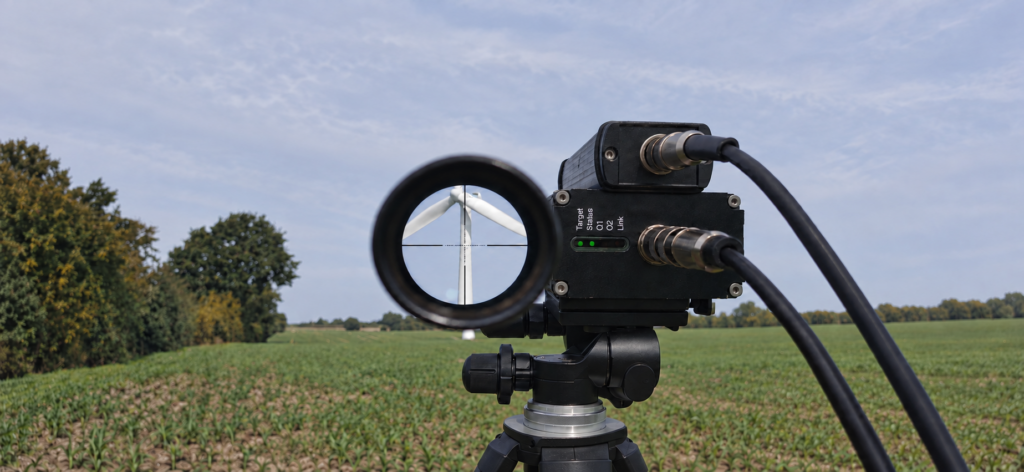
Rotor LDM determines relative blade angle differences from the blade passages recorded one after another during operation.
The focus is deliberately on comparing the three rotor blades. At the same time, blade position and deflection as well as the responses of the tower or nacelle are measured.
This makes it possible to investigate how uniformly the three rotor blades interact under real operating conditions and whether existing deviations have a recognisable effect on turbine behaviour.