Overview of Bridge Monitoring Methods
Different measurement methods are available for monitoring bridges. Strain measurement, acceleration measurement, temperature measurement, fibre-optic sensing, acoustic emission and deformation measurement capture different aspects of structural behaviour.
None of these methods alone describes the complete condition of a complex structure.
For effective Structural Health Monitoring, measurement parameters that provide different physical information are therefore useful. The key question is: Which change can be reliably observed with which measurement method?
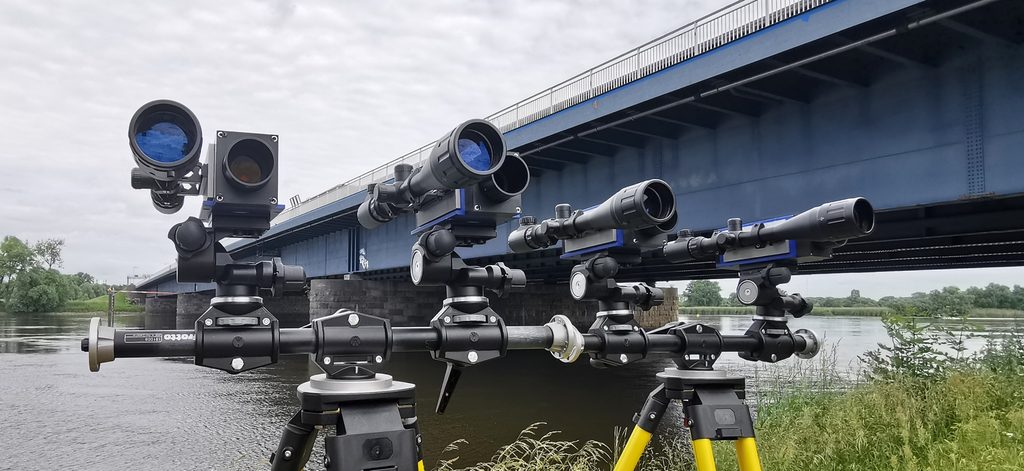
Bridge monitoring methods answer different questions
A sensor initially measures a specific physical quantity at a specific location.
A strain sensor measures local strain. Accelerometers capture dynamic movements. Temperature sensors describe thermal boundary conditions. Fibre-optic systems can measure strain over larger areas.
Global deformation measurement, by contrast, answers a different question:
How does the structure as a whole respond to a real load?
For Structural Health Monitoring, these different types of information can be combined.
Strain measurement
Strain sensors measure local changes in strain at defined positions of the structure.
They are particularly suitable where stresses are to be observed at known or particularly relevant areas.
However, the information is initially local. A change elsewhere in the structure does not necessarily appear clearly in an individual strain sensor.
Acceleration measurement
Accelerometers capture dynamic movements and vibrations of the structure.
This makes it possible, for example, to investigate natural frequencies, vibration modes or changes in dynamic behaviour.
Acceleration measurement therefore provides important information about the dynamics of a structure, but answers a different question from the direct measurement of deformation under load.
Temperature measurement
Temperature affects the behaviour of almost every bridge structure.
Temperature sensors are therefore an important component of many monitoring systems. They help distinguish thermally induced movements and changes from load-related structural responses.
Temperature itself is not an independent statement about structural condition, but an important boundary condition for interpreting other measurement parameters.
Fibre-optic measurement methods
Distributed Fibre Optic Sensing and other fibre-optic methods enable strain or other measurement parameters to be captured over longer sensor sections.
This allows spatially distributed information to be obtained and local changes along a monitored area to be detected.
The focus, however, remains on the measurement parameters along the installed fibre. The global deformation response of the entire structure under a traffic load represents a different level of information.
Acoustic Emission
Acoustic emission methods detect elastic waves that can arise, for example, from active damage processes within a material.
This makes it possible to observe processes that may be difficult to detect directly using other sensor methods.
Here too, the perspective differs from measuring the global deformation of the structure.
Global deformation measurement
Global deformation measurement observes how selected areas of the structure move under an applied load.
Multiple measurement lines make it possible to consider not only individual points, but spatial deformation patterns.
Recurring traffic events repeatedly provide new load situations. If comparable events are compared over long periods, it is possible to investigate whether the structural response changes.
The central question is:
Does the structure behave under comparable loads today in the same way as it did in the past?
What Bridge LDM contributes
Bridge LDM measures the global deformation response of a structure under real traffic loads.
Multiple laser measurement lines capture selected areas of the structure without contact. The measurement data are time-synchronised and can be compared with historical reference conditions.
This allows, among other things, the following to be considered:
- deformation behaviour under load
- spatial deformation patterns
- recovery after load events
- long-term zero positions
- bearing movements
- changes in structural behaviour over time
Bridge LDM does not replace strain, acceleration, temperature or material-related sensing.
It adds another level of information to these methods:
The real global deformation response of the structure under load.
Comparison of measurement methods
| Method | Typical measurement parameter | Level of observation | Typical information |
|---|---|---|---|
| Strain | local strain | local | stress at defined areas |
| Acceleration | vibration / dynamics | local to global | dynamic structural behaviour |
| Temperature | temperature | local / distributed | thermal boundary conditions |
| DFOS / fibre optics | distributed strain | local to spatially distributed | changes along a sensor section |
| Acoustic Emission | elastic waves | material-related | active material processes |
| Bridge LDM | deformation under load | spatial / global | actual structural response and changes over time |
The methods are therefore not necessarily in competition with each other. Combining them can increase the information provided by a monitoring system.
From individual sensors to Structural Health Monitoring
Structural Health Monitoring is not created simply by installing as many sensors as possible.
The key is that the measurement parameters can answer specific technical questions and be interpreted together.
For example, a change in the global deformation response can provide a reason to investigate local measurement parameters in greater detail. Conversely, a local anomaly can be compared with the behaviour of the structure as a whole.
This creates a multi-level approach:
local measurement → global structural response → change over time → technical assessment
Bridge LDM as an SHM component
Bridge LDM is deliberately designed in a modular way.
It can be used as a stand-alone monitoring system or integrated into existing Structural Health Monitoring systems. Existing data acquisition, additional sensors, servers and monitoring platforms can continue to be used.
Bridge LDM Analysis processes the laser measurement data and provides characteristic values and analysis results for further use. Via interfaces, this information can be integrated into higher-level monitoring and SHM systems.
The role of Bridge LDM is therefore not:
to replace all other measurement methods
but rather:
to provide the global deformation response under real loads as an additional SHM component